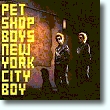
 New York City Boy
Writers - Tennant/Lowe/Morales
First released - 1999
Original album - Nightlife
Producer - Pet Shop Boys, David Morales
Subsequent albums - PopArt, Pandemonium, Ultimate, Inner Sanctum, Smash
Other releases - single (UK #14, US Sales #53, US Dance #1)
The second single from Nightlife became the Boys' seventh #1 dance-chart hit in the United States. Stylistically it's an outright homage to the Village People, from the small but full-throated male chorus to the dead-on late-seventies disco track. It's such an homage, in fact, that pre-release rumors had it that the Village People were appearing as guest vocalists. That's not the case—studio backup singers fill that bill. In June 2003 I submitted a question to the official PSB website, asking whether the Boys had ever seriously considered asking the Village People to sing backup on this track. Neil replied, "I think the idea was mooted," which means that the idea was probably proposed by one of them but obviously abandoned.
At any rate, this track (written in collaboration with its co-producer, the prolific DJ/remixer David Morales) seems to be one of those songs you either love or hate: some have derided it as an uncharacteristic PSB lapse in taste, while others have celebrated it for the rousing tribute that it is. It's noteworthy that "New York City Boy" was the first PSB track to make it onto Billboard's pop chart since 1991's "Where the Streets Have No Name (I Can't Take My Eyes Off You)" (as opposed to the dance charts, where our musical heroes were fixtures throughout the nineties). It got all the way up to #53 on the Sales chart without making it onto the Airplay chart, indicating that the single sold extremely well in the U.S. for a single with nary a shard of help from pop radio. No doubt it was the combination of New Yorkers and gay dance-club fans that did the trick.
Regarding the line "If you don't get that mix, it's gone 86," which many people find perplexing, Neil has said that it's American slang for something that has disappeared and is no longer available. Interestingly enough, its most likely roots are also in New York City. While there's some debate about the matter, the most widely accepted explanation is that it originated in the 1920s at Chumley's, a Greenwich Village speakeasy—still in existence but just a plain old bar nowadays—which had a reputation for throwing out disorderly customers. Since Chumley’s address was (and still is) 86 Bedford Street, people would joke that if you went there you might end up getting "86'ed." So perhaps it would be more accurate to say that it refers to something that has been "tossed out" or discarded.
Annotations
- As already noted, "New York City Boy" owes a strong stylistic debt to the music of the popular 1970s disco vocal group the Village People, and might even be regarded as an homage to them. The Village People consisted of six male singers each dressed in distinct "macho drag" as an icon of iconic/fetishistic stereotypical masculinity (cop, construction worker, cowboy, American Indian, soldier, and biker). They enjoyed a short string of hits during the period 1977-1979, including their biggest and best-known single, the U.S. #2 smash "Y.M.C.A." One of their lesser hits, "Go West," was famously remade by the Pet Shop Boys in 1993.
- It's worth noting that a former member of the Village People, original cowboy Randy Jones, returned the compliment in 2006 by recording a cover version of "New York City Boy"—doubly appropriate since, though a native of North Carolina, Jones has long called New York City home.
- The opening musical phrase of the song, played by strings and woodwinds, is clearly extrapolated from an instrumental phrase that appears repeatedly in the disco hit "Come Back" by Carol Williams, which hit #29 on the Billboard dance chart in early 1977. It's not a "sample" in that there are some differences between the two, especially after the strikingly similar first several notes, but the resemblance is indisputable. It's very likely intended as an homage or at least a "nod" on the Boys' part to a track that would undoubtedly have been played back in the heyday of disco at Studio 54. At the very least, it serves as a scene- or mood-setter, evoking the "Disco Era."
- During the song's bridge, a near-sample of the recurring horn fanfare from Donna Summer's famed rendition of "Macarthur
Park" can be heard. It's not really a sample, but comes awfully close. Most likely it's a "reconstruction" that serves as something of another homage.
- Another possible influence on this track is the classic 1977 disco track "Native New Yorker" by Odyssey, particularly with regard to that song's "New York City girl" background vocals.
- "Wanna go and wander in the ticker-tape" – Since the only time someone is likely actually to "wander in the ticker-tape" would be during one of the very occasional ticker-tape parades granted by New York City to popular heroes of some sort (be they moon-landing astronauts or victors in the World Series), its usage here is probably intended to be metaphorical. That is, to "wander in the ticker-tape" would be to walk down New York's Wall Street, the traditional source of tape from stock-tickers. It's worth noting, however, that since nowadays stock-tickers have been completely replaced by digital devices that don't put out tape, any "ticker-tape" these days would have to be generated specifically for the purpose of such a parade—and probably not even by an honest-to-goodness stock-ticker.
- "Where Seventh Avenue meets Broadway" – Seventh Avenue and Broadway are major thoroughfares in the Manhattan district of New York City. In fact, Seventh Avenue intersects with Broadway at Times Square, world-famous as the commercial heart of Manhattan, nicknamed "The Crossroads of the World."
- "The hoochies unreal" – Surprisingly vulgar slang for a PSB lyric: a "hoochie" is a girl who will have sex with anyone, aka a "slut," or at least a girl who dresses so provocatively as to suggest she is a "slut." Its origin is uncertain, but it's believed to have entered America in the 1950s via former U.S. serviceman who had been stationed in post-war Japan, where the word uchi commonly referred to a whorehouse or a prostitute's dwelling.
- "That's the bomb!" – "Da bomb!" or "Tha bomb!" was 1990s African-American street slang for something really great. Its articulation in the song as "the bomb," though timely, betrays a degree of inauthenticity. It's not inconceivable, however, that the Boys were fully aware of such inauthenticity and were purposefully evoking it as befitting a perhaps somewhat naive protagonist. In the wake, however, of 9/11 and the "war on terror," I would imagine such "bomb" slang—authentic or otherwise—would now be considered passé and perhaps downright distateful on the streets of New York City.
- "It's gone eighty-six" – As a related addendum to the slang usage of "eighty-six" described above, it's also apparently common restaurant slang for running out of an item; that is, to "86 the pork chops" is to run out of them. And in bars it can mean to be thrown out; to be "eighty-sixed" is to be forcibly ejected.
- One of my site visitors has made the fascinating observation that a musical phrase near the beginning of "New York City Boy"—specifically the orchestral line that appears about seven seconds into the album track, after the opening woodwinds-and-strings fanfare but before the background vocalists start singing the title phrase—bears a strong resemblance to the primary melodic motif of the 1893 song "Hearts and Flowers," composed by the German-born American musician Theodore Moses-Tobani (with rarely used lyrics by Mary D. Brine), itself based on a motif from the 1891 work Wintermärchen Waltzes by the Austro-Hungarian composer Alphons Czibulka. "Hearts and Flowers" gained tremendous popularity in the late 1890s as a sentimental favorite, and very soon began to be used as a heart-tugging instrumental cue in vaudeville and early motion pictures. Within two decades of its first appearance, it had already become a cliché. Before long, the cliché transformed it into comedy. Modern listeners will undoubtedly be familiar with it through, if nothing else, its frequent use in Warner Brothers cartoons (Bugs Bunny et al.) to evoke mock tragedy. At any rate, there's no disputing the similarity of the two melodic phrases—they're by no means identical, but they're decidedly very much alike—though whether it's coincidental or intentional is anybody's guess. My site visitor, however, speculates that the Boys may be employing this melodic "takeoff" quite intentionally to suggest the initial sadness and boredom felt by the "New York City boy" to whom Neil is presumably singing as he encourages him to take advantage of the opportunities that life in the Big Apple has to offer.
- The 2001 single "Last Exit to Brooklyn" by the German duo Modern Talking (from their America - The 10th Album) doesn't actually "sample" this song, but it does make some distinct allusions to it. Not only does its lyrics include the phrase "New York City boy," but its repeated exhortations to "Party up!" clearly echo similar background vocals in the PSB track. Fascinatingly, in a bit of apparent musical cross-pollination, it sounds as though the Boys may be borrowing the sound and feel of the pertinent segments of the Modern Talking track in the extended "Party up!" chanting during their live renditions of "New York City Boy" during their multi-year Dreamworld shows of the 2020s—although this, of course, may be purely coincidental.
Mixes/Versions
Officially released
- Mixer: David Morales
- Album version (5:15)
- Available on Nightlife
- Radio Edit (4:21)
- Radio Edit #2 (3:47)
- MX Radio Edit (3:47)
- The Radio Edit #2 and the MX (Mexican) Radio Edit—the latter of which was released exclusively on an official Parlophone Mexican promo single—are apparently virtually identical, but differing in the mix of the chorus starting at 1:42. Only in the Mexican verion can you hear a second voice "answering" Neil, twice repeating "New York City."
- US Radio Edit (3:35)
- US Radio Edit (re-edit) (3:20)
- Available on PopArt
- "US Radio Edit One" (3:20)
- Available on an EMI promo compilation issued in Canada; the only difference between these two 3:20 "US Radio Edits" can be heard during the instrumental bridge starting at about 2:12, where the instrumentation is noticeably different
- The Morales Club Mix (10:54)
- Album version (5:15)
- Mixer: The Almighty
- The Almighty Definitive Mix - Edit (6:31)
- Available on the Nightlife "Special Edition" bonus disc
- The Almighty Man on a Mission Mix (6:49)
- The Almighty Definitive Full-Length Mix (8:51)
- Available on an Almighty Records DJ promo
- The Almighty Definitive Mix Radio Edit (4:08)
- Available on an Almighty Records DJ promo
- The Almighty Definitive Mix - Edit (6:31)
- Mixer: Lange
- The Lange Mix (7:06)
- Available on the Nightlife "Special Edition" bonus disc and on the bonus third disc ("Mix") with the "Special Edition" of PopArt
- Mixer: Tom Stephan (as Superchumbo)
- The Superchumbo Downtown Mix (aka "Superchumbo's Downtown Dub") (7:44)
- The Superchumbo Uptown Mix (aka "Superchumbo Club Mix") (9:44)
- Available on the Nightlife "Special Edition" bonus disc
- Mixer: Thunderpuss
- The Thunderpuss 2000 Club Mix (10:55)
- Available on the Nightlife "Special Edition" bonus disc
- The Thunderdub (8:21)
- The Thunderpuss 2000 Radio Edit (4:18)
- Mixer: Stuart Price
- Pandemonium CD live version (2:51)
- Inner Sanctum CD live version (3:40)
Official but unreleased
- Mixer: David Morales
- Morales Dub (7:10)
- Morales Dub Beats (5:15)
- Thunderpuss
- Thunderdrum-a-Pella (8:11)
List cross-references
- The 10 biggest PSB hits on the U.S. Billboard dance charts
- My 10 favorite PSB remixes (not counting hit single and original album versions)
- The key signatures of selected PSB songs
- Celebrities portrayed in the "New York City Boy" video
- Real places mentioned by name in PSB songs
- Tracks that mention "Pet Shop Boys"
- Tracks by other artists that sample the Pet Shop Boys
- The 10 longest commercially released "official" PSB remixes
- The Pet Shop Boys' appearances on Top of the Pops
- PSB songs that have been used in films and "non-musical" TV shows
- PSB tracks appearing in videogames
- How PSB singles differ (if at all) from the album versions
- What it's about: Neil's succinct statements on what a song is "about"
- Songs performed live most often by PSB
- Nods to PSB history in the "A New Bohemia" video
All text on this website aside from direct quotations (such as of lyrics and of other nonoriginal content) is copyright © 2001-2026 by Wayne Studer. All Rights Reserved. All lyrics and images are copyright © their respective dates by their respective owners. Brief quotations and small, low-resolution images are used for identification and critical commentary, thereby constituting Fair Use under U.S. copyright law. Billboard chart data are copyright © their respective dates by Billboard Media, LLC.