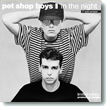
 In the Night
Writers - Tennant/Lowe
First released - 1985
Original album - Disco
Producer (original version) - Phil Harding, Pet Shop Boys; (1995 version) - Pet Shop Boys
Subsequent albums - Alternative, Format, Please 2001 reissue Further Listening 1984-1986 bonus disc, Bilingual 2001 reissue Further Listening 1995-1997 bonus disc, Inner Sanctum
Other releases - b-side of 1985 single "Opportunities"; bonus track with single "Before"
Neil has stated that this song (the 7" version of which was the b-side of the Boys' first Parlophone single, "Opportunities") was inspired by his reading of a book by David Pryce-Jones about Paris during the German occupation of World War II. In it, Pryce-Jones wrote of les Zazous, long-haired proto-beatnik dissidents who conscientiously chose not to take sides with either the Nazis or the Resistance, but instead "opted out." As a result, they were distrusted and hated by both sides. The Nazis disdained them as depraved and decadent, while the French Resistance regarded them as collaborators. Obviously Neil was intrigued by the dramatic possibilities of being in such an ambiguous and precarious position.
Stylistically the song betrays the influence of American producer "Bobby O" Orlando, with whom Neil and Chris were working at the time. (In particular, note the strong musical similarity to the cult classic "Passion" by the Flirts, written and produced by Bobby O.) A British TV program devoted to fashion, The Clothes Show, used part of "In the Night" as its theme song, which prompted the Boys to record a new version in 1995. The newer rendition, an instrumental, replaced the old one as the TV theme music and was released as a bonus track on the "Before" single.
Oh, and in case you're wondering how things turn out for the Zazou addressed in this song, I would be remiss not to point out that its music ends with a percussive effect highly reminiscent of the firing of a machine gun. Make of that what you will.
Annotations
- As noted above, the lyrics were inspired by the 1981 book Paris in the Third Reich: A History of the German Occupation, 1940-1944 by historian David Pryce-Jones.
- "Zazou, what you gonna do?" – As noted above, the narrator is addressing one of "les Zazous," dissident French youth who tried to stay aloof from politics during the Nazi occupation of the Second World War. The Zazous were enthusiasts of jazz music, and in fact probably got their name from scat-style nonsense syllables sung by American jazz vocalist and bandleader Cab Calloway—particularly his 1933 hit "Zaz Zuh Zaz." They were generally distrusted by both the Nazis and the French Resistance, and hence led a somewhat tenuous "borderline" existence.
- "Comment allez-vous?" – French, literally meaning "How do you go?" but used idiomatically to mean "How is it going for you?" or "How are you?"
- "A knock on the door in the night" – Something to be feared, to be sure. Who wouldn't be fearfully dismayed being awakened in the middle of the night by a knock on the door? This is of course especially true in oppressive totalitarian regimes (such in Germany and German-occupied territories during World War II), where secret police and other such authority figures are notorious for rounding up dissidents and other alleged "enemies of the state" under the cover of darkness. Interrogation, torture, and/or murder are likely to follow.
- "Down to Select or Le Colisée" – Select and Le Colisée, popular hangouts for the Zazous, were nightclubs in Paris during World War II.
- "… there's a thin line between love and crime and collaboration" – A takeoff on the familiar English-language aphorism "There's a thin line between love and hate." The implication here, of course, is that in occupied Paris (not to mention other places) acts of love could be viewed not only as criminal but also as evidence of collaboration with the enemy, which could certainly earn you the hatred of others. The French dealt in a notoriously harsh manner with Nazi collaborators during and immediately after World War II. It's estimated that more than 10,000 French collaborators were executed and more than 38,000 imprisoned. This doesn't even include the countless acts of public degradation and humiliation to which collaborators—many of them women who'd had relationships with German officials and soldiers—were often subjected post-liberation.
Mixes/Versions
Officially released
- Mixer:
Pet Shop Boys and Phil Harding
- 7"
version (4:51)
- Available the b-side of the first "Opportunities" single, on Alternative, the Further Listening bonus disc with the Please reissue, and on a rare German promo single
- 7"
version (4:51)
- Mixer:
Arthur Baker
- Arthur
Baker Remix (4:26)
- Available on certain versions of the "Paninaro '95" single
- Arthur Baker Remix Edit (aka Promo Edit, aka 7" Edit) (3:39)
- Extended
Mix (6:28)
- Available on Disco and Essential
- Arthur
Baker Remix (4:26)
- Mixer:
Bob Kraushaar
- "1995
Version" aka "In the Night 95" (4:18)
- Available on the Further Listening bonus disc with the Bilingual reissue and on Format
- "1995
Version" aka "In the Night 95" (4:18)
- Mixer: Stuart Price
- Inner Sanctum CD live version in medley with "The Pop Kids" and "Burn" (11:11)
Official but unreleased
- Mixer: Arthur Baker
- Arthur Baker Dub 1 (6:05)
- Arthur Baker Dub 2 (5:55)
List cross-references
- The key signatures of selected PSB songs
- PSB songs with literary references
- PSB lyrics that include non-English words and phrases
- Real places mentioned by name in PSB songs
- PSB songs for which the Boys have acknowledged the influence of specific tracks by other artists
- Tracks by other artists that sample the Pet Shop Boys
- PSB songs that have been used in films and "non-musical" TV shows
- PSB "singles" that weren't
- The 13 least likely subjects for pop songs that the Pet Shop Boys nevertheless turned into pop songs
All text on this website aside from direct quotations (such as of lyrics and of other nonoriginal content) is copyright © 2001-2025 by Wayne Studer. All Rights Reserved. All lyrics and images are copyright © their respective dates by their respective owners. Brief quotations and small, low-resolution images are used for identification and critical commentary, thereby constituting Fair Use under U.S. copyright law. Billboard chart data are copyright © their respective dates by Billboard Media, LLC.